
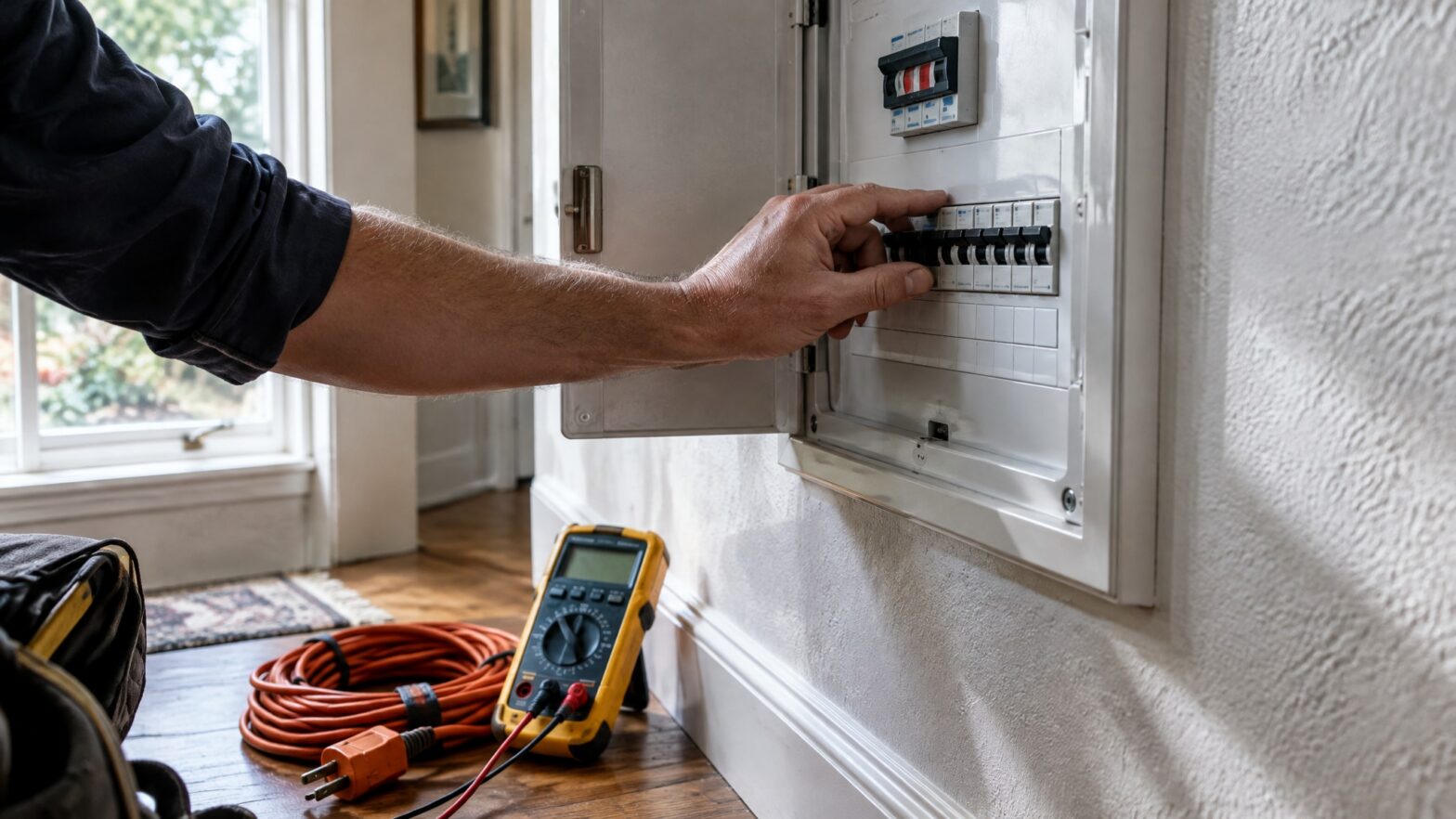
When the power drops out or a switchboard starts tripping, the first job is finding an electrician who can get there. For most households and sites in the Southern Highlands, that means someone based in the area.
This guide explains what a local electrician is, where being local helps, and where it doesn’t. It also covers what to check before booking.
What “Local” Means When You Hire an Electrician
A local electrician lives and works in the area they service. The business is based there, the vans start the day there, and the people who answer the phone know the roads and the suburbs.
That rules out a few things. It isn’t a call centre that passes jobs to whichever contractor is free. It isn’t a Sydney or Wollongong business that travels up the highway when it has a gap in the schedule.
Ozelect is a Moss Vale based electrical contracting business. It serves residential, commercial and industrial clients across the Southern Highlands, from household repairs through to larger commercial and industrial jobs.
Local describes where a business operates, not how well it works. A nearby electrician who isn’t properly licensed is still the wrong choice, and the licensing section below covers that.
Why a Local Electrician Is Often the Better Choice
“Often” is the right word. Being close to the job gives a contractor two real advantages, and neither is a guarantee.
Faster response when something fails
A tripped switchboard, a dead circuit or a burning smell from a power point can’t wait for a convenient week. Travel time is the part of a callout nobody can speed up, and a contractor starting from Moss Vale has far less of it than one driving in from a metro area.
Take a typical case. A storm moves through, and an older home in the Highlands loses power to half its circuits. The owner needs to know whether the fault is inside the house or out on the street. A local electrician can usually attend sooner than one travelling from Sydney, and can start sorting it out the same day the problem shows up.
There is a limit here. If a storm has taken out power across a whole street or town, the fault sits with the network operator, and no electrician can restore that supply. A local electrician can check the property side, make it safe and get it ready for the power to come back on.
A shorter trip also helps with the follow-up. Returning to finish a job, or to look at something that has failed again, is a smaller commitment for a contractor who is already in town.
Knowing local conditions and housing stock
The Southern Highlands has its own electrical problems, and an electrician who works here every week has seen most of them.
- Older homes. Many Highlands houses carry wiring and switchboards that were installed decades ago and extended piecemeal since. A local electrician knows what tends to be behind the walls.
- Cold winters. Heaters, heated floors and electric blankets lift the load on circuits through the cold months, and weak points tend to show then.
- Rural and semi-rural supply. Properties on the edge of town often sit at the far end of the supply, with longer cable runs and different set-ups from a suburban block.
- Storm-related outages. Wind, lightning and fallen branches cause faults and damage. Local tradespeople see the pattern after each storm season.
A contractor who has worked on a street before also knows what to expect before opening the switchboard door. That saves time on the first visit and cuts down on surprises.
Local Electrical Services for Homes
Homeowners usually call for one of four things: a repair, new lighting or power points, an upgrade to wiring or the switchboard, or a safety check. Ozelect’s residential electrical services cover all four.
The range runs from small household repairs to bigger upgrades. One electrician can handle both ends of that range, so a homeowner doesn’t need a different contractor for each job.
Repairs, wiring and switchboard upgrades
Repairs come first for most people. That means faulty power points, circuits that keep tripping, lights that flicker or fail, and anything that has stopped working without warning.
Lighting and power points are the everyday installation jobs. A new room, a renovation or a change in how a space is used often needs more outlets or a different lighting layout.
Wiring and switchboard upgrades are the bigger jobs. An old switchboard that can’t cope with a modern household’s demand is a common reason, and so is a renovation that adds load the existing wiring wasn’t built for. An upgrade also sorts out the problem of a board that trips whenever the heater and the oven run at the same time.
Upgrades are a planned job. They suit someone who wants the work done properly, not a quick patch to get through a bad night.
Safety checks for older properties
Older properties need attention before anything fails. A safety check looks at the condition of the switchboard, the wiring and the outlets, and flags anything worn, overloaded or out of date.
This matters most in a house that has changed hands, or one where nobody can say when the electrics were last looked at. A check won’t turn old wiring into new, but it tells the owner what is sound, what needs work and what can wait.
Local Electrical Support for Commercial and Industrial Sites
For a business, an electrical fault means lost trade. A shop with dead lighting or a workshop with a failed circuit stops earning until it is fixed, so response time matters more than it does at home.
Ozelect handles commercial and industrial electrical work across the Southern Highlands, including ongoing maintenance as well as one-off jobs.
Maintenance that keeps sites running
Site operators tend to prefer one nearby contractor for regular work. The electrician learns the site: how the switchboards are laid out, where the older equipment sits and which circuits carry the heavy loads.
That knowledge speeds up every later visit. Nobody has to re-learn the building each time something goes wrong, and small faults get picked up during routine work instead of turning into shutdowns.
Compliance is the other reason. Commercial and industrial sites have electrical obligations, and a contractor who is nearby and knows the site is easier to call back when something needs checking or documenting.
A local contractor won’t suit every job. Very specialised industrial installations may need extra expertise, and an operator should ask plainly whether the electrician has done that type of work before.
Strata and property manager needs
Property managers and strata committees deal with shared systems, tenants who report faults and owners who want costs kept in check. A single local contractor who knows the buildings makes that easier to manage.
There is more on this in the guide to electrical work for strata properties in Moss Vale.
How to Check a Local Electrician Is Properly Licensed
Being local does not replace being licensed. Electrical work is regulated in NSW for good reason, and a nearby electrician without the right paperwork is a risk to the property and the people in it.
Homeowners who want the full checklist can read how to choose a licensed electrician in NSW. The basics are below.
Licence, insurance and compliance paperwork
Three things should be in place before any work starts.
A current NSW electrical licence. Electricians must hold one to do electrical work in the state. NSW Fair Trading runs a licence check, and a homeowner can look up the licence number there to confirm it is current and covers the work.
Insurance. A genuine contractor can show proof of cover. Ask for it before the job, not after something goes wrong.
Compliance paperwork after the job. A licensed electrician provides compliance documentation for the work done. In NSW this is usually a Certificate of Compliance for Electrical Work. Keep it, because it records what was done and can matter when the property is sold or an insurer asks questions.
An electrician who is vague about any of these three is worth avoiding, however close to town they are.
Questions to ask before booking
A short phone call settles most of it. Homeowners and site managers can ask:
- What is your NSW electrical licence number?
- Do you carry insurance for this type of work?
- Will I receive compliance paperwork when the job is finished?
- Have you done this kind of job before, such as a switchboard upgrade or a commercial fit-out?
- Can you explain what the fault is and what it will take to fix it?
A good electrician answers these without fuss. Hesitation on a licence number is a reason to look elsewhere.
Local Trades in the Southern Highlands: Other Meanings of “Local”
People who search “local” are often after different things. Some want local shops or cafes, some want a phone number with a local area code, and some want whatever Google lists as nearby. For most services, “local” in a search means a business close to the searcher.
For trades, nearby also means practical. A tradesperson who works in the area can reach a job quickly and return when needed. This guide covers local trades only, specifically electricians.
Hiring a Highlands business keeps work in the region. The money stays with people who live in Moss Vale and the surrounding towns, and the electrician fixing a fault is often a neighbour or knows one.
Getting Local Electrical Help in Moss Vale
A call goes faster when the electrician has the facts up front. Before ringing, a customer should have these ready:
- The fault or the job. What happened, when it started, and what has been tried. For an upgrade, what the customer wants changed.
- The address. The full address, plus anything useful about access, such as a locked gate or a rural property with a long driveway.
- Photos of the switchboard. One clear shot with the cover open, and one close up of any switch that has tripped or any label that has been marked.
If something smells burnt, sparks or feels hot to touch, the customer should turn off the power at the main switch if it is safe to do so and leave the circuit alone until an electrician arrives.
Ozelect serves Moss Vale and the Southern Highlands region of NSW. To book a repair, an upgrade or a safety check, contact Ozelect with the details above and a licensed local electrician will take it from there.
Frequently asked questions
Who counts as a local electrician?
A local electrician is based in the area they service and works there day to day. A Moss Vale business that attends jobs across the Southern Highlands qualifies. A call centre or a contractor travelling in from Sydney or Wollongong does not.
Does “local” in a Google search mean a nearby business?
Yes. Google generally lists businesses that are close to the searcher’s location or to the place named in the search, such as Moss Vale. Nearby is not the same as qualified, so a homeowner still needs to confirm the electrician’s NSW licence.
What is a local number in Australia?
A local number is a landline with the area code for the region, which is 02 for most of NSW including the Southern Highlands. Numbers starting with 13 or 1300 are also charged at a local call rate. A local number suggests a nearby base but does not prove it, so check the business address as well.
How do I check an electrician is licensed in NSW?
Ask for the electrician’s licence number and look it up using the NSW Fair Trading licence check. Confirm the licence is current and covers the work. Also ask for proof of insurance and for compliance paperwork once the job is done.
Can a local electrician fix a power outage across my whole street?
Not if the fault is on the network. Street-wide outages are the network operator’s responsibility. An electrician can check the property side, make sure the switchboard and circuits are safe, and sort out any damage the storm caused inside the property.