
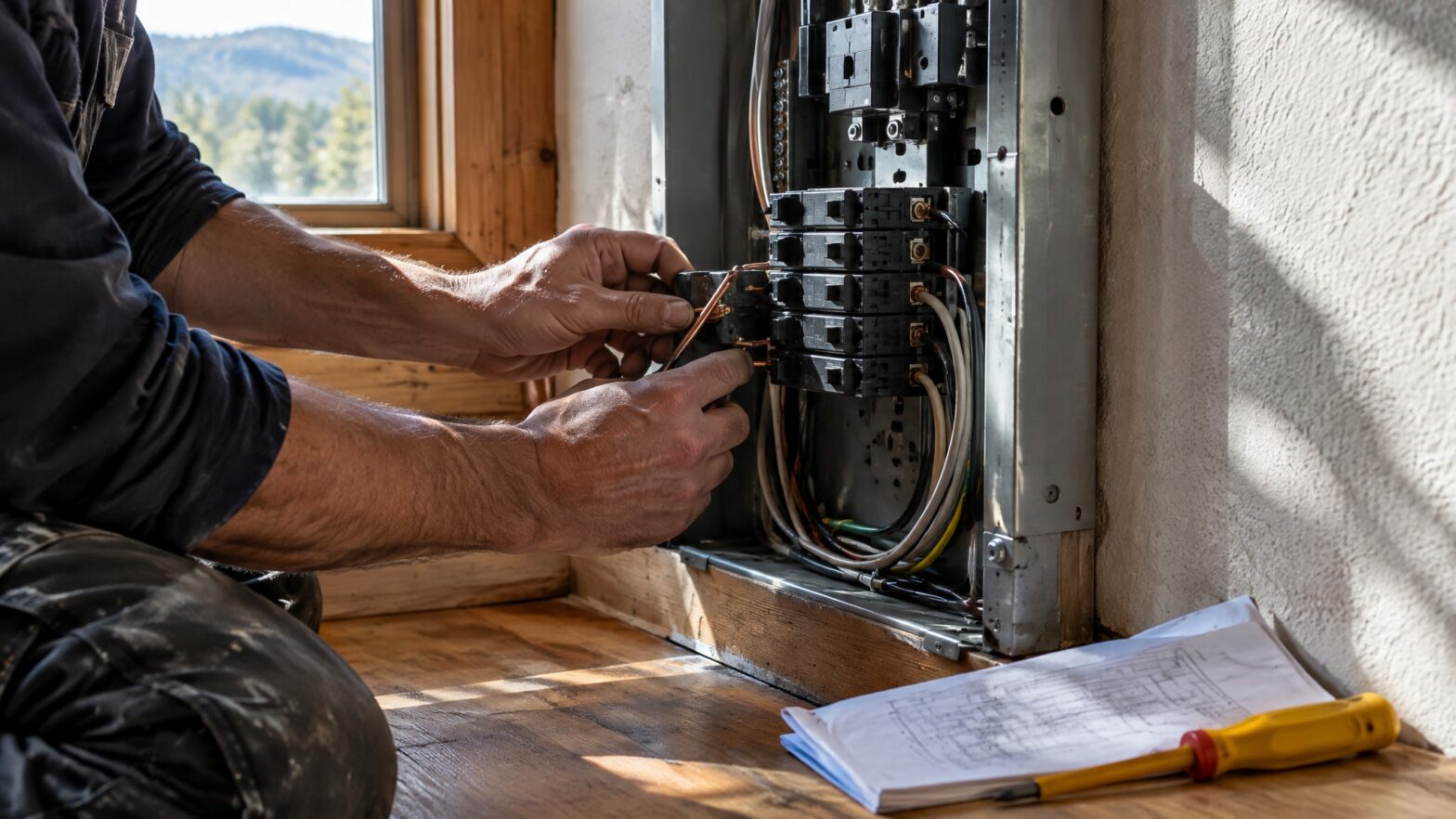
Licence status is the first thing to settle when you hire an electrician in the Southern Highlands. Price, availability and reviews all come second. An unlicensed job can look fine on the day and still leave you with unsafe wiring and no paperwork to prove the work met the standard.
This guide covers how to choose a licensed electrician in NSW. It focuses on the red flags local buyers actually run into: quotes with no licence number, cash deals, no certificate and no proof of insurance.
Licensed vs unlicensed electrical work in NSW
The line in NSW is simple. If a job alters, adds to or connects to fixed wiring, it is licensed work.
That covers new wiring and circuits, power points, switchboards, and hardwired smoke alarms. It also covers fault-finding inside walls and ceilings. Changing a light globe, plugging in an appliance or resetting a safety switch at the board does not need a licence.
A general builder or handyman cannot legally do the wiring, even when they run the rest of the job. On a renovation, the builder must bring in a licensed electrician for the electrical part, and you are entitled to ask who that is.
Unlicensed work also costs you the paperwork. Without a licensed electrician there is no valid Certificate of Compliance, so if the work turns out to be faulty, you are the one holding a defective installation with nothing to show how it was done or who did it.
This is not a rule you can waive for “small” jobs. A single power point is licensed work.
How to check a licensed electrician in NSW
The check takes a few minutes and costs nothing. Do it before you accept a quote, not after the first visit.
Confirm the licence number, class and status
Take the licence number from the quote and search it on the NSW Government public licence register. Use the register itself, not a third-party lookup site, because only the register shows the current status.
Check three things on the entry:
- The licence is current, not expired, suspended or cancelled.
- The class covers the job. A restricted licence only covers its listed scope, so it may not extend to a full rewire or a switchboard upgrade.
- The name on the register matches the business name on the quote.
Work on the network connection or the meter can also need separate network accreditation, so if your job involves either, ask the electrician to confirm who is authorised to do that part.
A register check tells you the licence is real and current. It does not tell you how good the work is, so it is the first filter, not the last.
Make sure the person on site is licensed too
A licence number on the quote only protects you if the person doing the work is licensed as well. A business can hold a licence while someone else turns up with tools and no authority to do the wiring.
Ask for the name of the electrician attending and look that person up on the register too. If the business sends an apprentice, that is normal, but the licensed electrician must supervise and sign off the work. A straight answer names the person. A vague one (“one of the boys will be out”) is a reason to stop and ask again.
Red flags in quotes that point to unlicensed work
Most unlicensed work gives itself away before anyone picks up a tool. The signs show up on the quote and on the first phone call, and each one is a stop until the licence is checked and the quote names both the licensed person and the business.
Quotes that skip the licence details
A proper quote is a document you can verify. Be wary when it shows any of these gaps:
- no licence number, or a number that does not match the register
- no ABN, or only a first name and a mobile number
- no insurance details
- no business name, so you cannot match anything to the register
- a vague scope such as “electrical work, supply and install” with one lump price
- a line like “no licence needed for this job”
That last line deserves its own warning. In NSW, wiring work needs a licence whatever the size of the job, so anyone telling you otherwise is either mistaken or hoping you will not check.
Cash deals and no-paperwork talk
The phone call can be just as telling as the paper. A price given only verbally, with no offer to put it in writing, is a red flag. So is pressure to start today “while the van is nearby”.
The clearest warning is a discount for paying cash. A typical case: someone quotes over the phone to add a power point or upgrade a switchboard, offers a lower price for cash, and never mentions a licence number or ABN. The discount exists because there will be no paperwork, and no paperwork means no Certificate of Compliance.
Checking the licence number on the register before you pay any deposit is the test that separates that job from a licensed one. If the person cannot give you a number to check, you have your answer.
Electrical compliance certificates and insurance in NSW
Two documents separate a finished job from a job you can stand behind: the certificate the electrician issues, and the insurance they hold. Ask about both before work starts, because it is much harder to chase them afterwards.
What the Certificate of Compliance should show
Electrical work in NSW generally needs a Certificate of Compliance from the licensed electrician who did it. Treat the electrical compliance certificate as part of the job, not a favour. It should show:
- the name and licence number of the licence holder
- the address where the work was done
- a description of the work carried out
- the date of the work
Keep a copy with your property records. You may need it when you sell, when a buyer’s inspector asks questions, or when someone later has to work out what is behind a wall.
A job finished without a certificate is a red flag, not a paperwork delay. If an electrician says the certificate will “come later” and later never arrives, treat the work as unverified and ask a different licensed electrician to inspect it.
Public liability insurance: ask for the certificate of currency
A verbal “we’re insured” is not proof. Ask for a current certificate of currency for public liability insurance and read the dates, because a policy that lapsed last month looks identical to one that is live until you check.
If the business employs staff, also ask about workers’ compensation cover. A sole trader working alone may not need it, but a business sending a crew should have it, and a reliable one will email the documents without fuss.
Insurance does not make poor work good. What it does is give you somewhere to turn if something goes wrong on your property, which is why a missing certificate of currency should hold up the deposit.
Questions to ask an electrician before you choose one
You already have the licence, certificate and insurance checks. These questions cover the rest, and the way someone answers matters as much as what they say.
- Who does the work. A straight answer names the licensed electrician and says whether an apprentice will assist. Dodging the question is a reason to look again.
- How extras are priced. Expect a clear statement that variations are quoted and agreed in writing before the work goes ahead. “We’ll sort it out on the day” is not an answer.
- Deposit and payment terms. The quote should say what is due and when. A large deposit demanded up front, or payment only in cash, should make you stop before you pay anything.
- Workmanship warranty. A reliable electrician states the warranty on their work plainly and puts it in writing. If they cannot say what it is, assume there isn’t one.
- How fast they can attend. For a fault or an outage, ask how quickly someone can reach you. A realistic time frame beats a promise of “straight away”.
If a deposit is requested and any answer above was vague, hold the money until it is cleared up in writing.
Finding a reliable local electrician in the Southern Highlands
Local matters for practical reasons. An electrician based in the region can reach you quickly, returns for follow-up work, and has a reputation to protect among the same people you know.
Older homes and rural properties are a good example. Across the Southern Highlands, original wiring often sits alongside later additions such as pumps, sheds and solar, and the combination needs someone who has handled mixed work before. You are within your rights to ask directly whether the electrician has done that kind of job.
If you manage shared property, the same questions apply. Owners corporations and managers can look at the page for an electrician for strata properties in Moss Vale as a starting point for the same licence and insurance checks on common-area work.
Local reputation you can check
Reputation is only useful when you can verify it. These are the things worth looking for:
- A Moss Vale or Southern Highlands base, not a call centre that sends someone from elsewhere.
- Local references the business can name, so you can call a past client yourself.
- Reviews that describe the actual work, such as a switchboard upgrade or a fault found, rather than a star count with no detail.
- A clear policy for urgent and no-power callouts, including who answers the phone and how fast they attend.
Ask for these. A business with real local work behind it can usually offer them without hesitation.
Run the same checks on Ozelect
Ozelect is a Moss Vale-based electrical contracting business serving residential, commercial and industrial clients across the Southern Highlands. That gives you a base to check and a local name to ask about, and the same tests apply to Ozelect as to any other electrician.
Start with the licence. Ozelect can supply its licence details for you to search on the NSW Government register, and Ozelect’s background and licensing details are on its About page. Match the business name and number to the register entry, confirm the class suits your job, and ask who will attend.
Then ask for the paperwork: a written quote with the licence number and ABN, a current certificate of currency for its insurance, and a Certificate of Compliance when the work is finished. Ask for local references too. Ozelect can offer them, so you can speak to someone nearby about the actual work.
Check the licence on the NSW register first, then request a written quote from Ozelect through the Contact page and ask for it itemised.
Frequently asked questions
Can I replace a power point myself in NSW?
No. Power points are part of the fixed wiring, so replacing or adding one is licensed electrical work. You can change a light globe or plug in an appliance, but anything that touches the fixed wiring needs a licensed electrician and a Certificate of Compliance.
Is a licence number on the quote enough to prove an electrician is licensed?
No. The number has to match a current entry on the NSW Government public licence register, and the class has to cover your job. The person who actually turns up must also hold a licence of their own.
What should I do if I paid cash and never got a Certificate of Compliance?
Treat the work as unverified. Ask a licensed electrician to inspect it and tell you what they find, and keep any record you have of who did the work and what you paid. If the original tradesperson claimed to be licensed, you can also raise it with NSW Fair Trading.
Does Ozelect do commercial and industrial work as well as home repairs?
Yes. Ozelect is a Moss Vale-based electrical contracting business serving residential, commercial and industrial clients across the Southern Highlands. Whatever the job, run the same licence, quote, certificate and insurance checks before you book.